Television, is it making your kids fat?

The other day, I was sitting down watching a show on the Disney Channel, and up comes a commercial for McDonald’s illustrating delicious chicken nuggets, french fries, a soda and a Barbie Spy Squad cell phone toy. My daughter immediately turns to me and says, “Dad, can we go to McDonald’s tonight for dinner? I really want that phone!” During the show, I noticed that this wasn’t the only fast food commercial my child was viewing.
Restaurants and super market stores are filled with high calorie foods that lack nutritional value, many packaged with bright colors and cartoon characters to specifically entice children. The impact of these types of foods when eaten regularly and often can have negative health benefits such as increasing the risks for type 2 diabetes, high blood pressure, increased BMI and obesity.
The more often we indulge, and respond to the impulse eating of junk food, the more we crave these foods. Food is very closely linked to our behavioral and psychological emotions and when we eat something to feel better, our brains remember it, and we want to eat it the next time we need to feel a boost. These behavioral and psychological emotions reinforce negative eating habits such as “bingeing”, “withdrawal” and “cravings”.
For this reason, research regarding the impacts of marketing strategies has become a critical topic of concern in recent years. Marketing food to children through brand association, tie-ins for toys and nonfood items affect food habits and choices among children and adolescents.
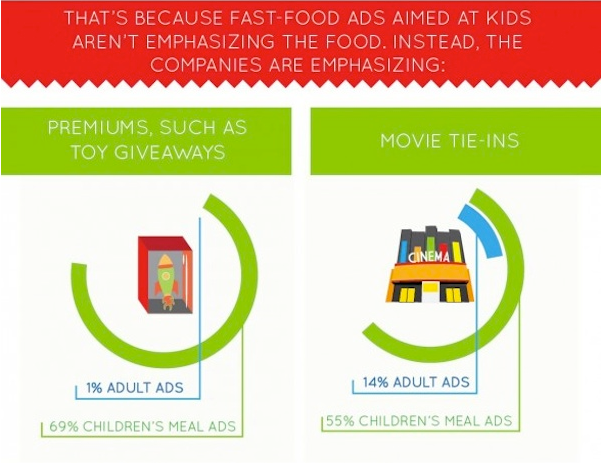
Several federal and corporate agencies strive to regulate the guidelines for advertising to children, and issue recommendations to grocery stores and fast food restaurants. McDonald’s and Burger King have been cited for noncompliance of these regulations by overemphasizing toys and other non-food items.
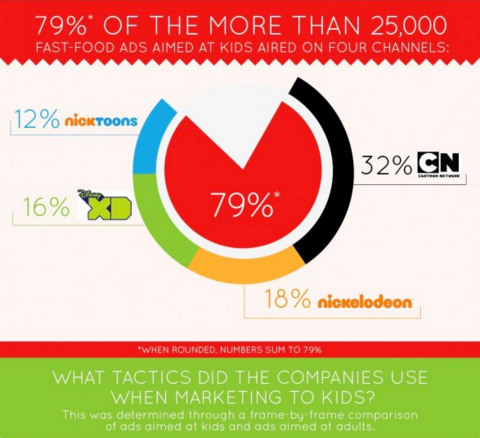
Research showed that the top 25 restaurants regularly marketed fast food children’s meals during peak times on children’s networks including Nickelodeon and Cartoon Network.
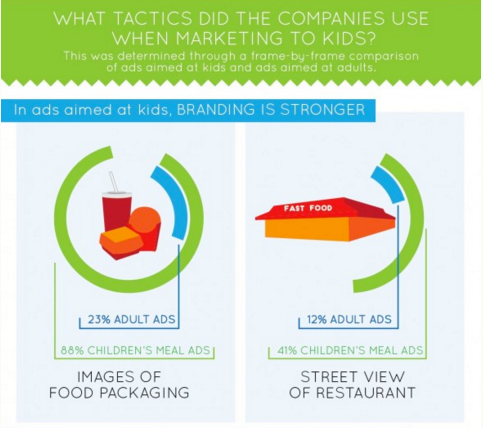
Children’s advertisements frequently emphasized aspects such as street views of the restaurants, toy premiums, and movie tie-ins, which emphasize brand recognition more than the type or quality of food. Toy premiums and tie-ins are more common in children’s advertising and rarely appear in adult food commercials.
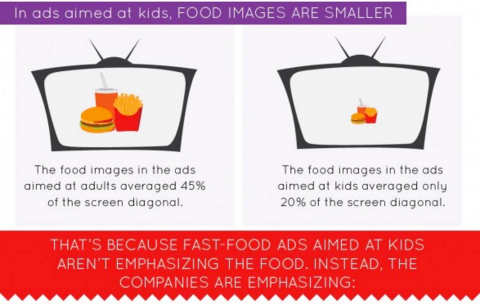
Additionally, the ads targeted toward children make the actual food smaller on the screen than ads aimed at adults, further emphasizing the restaurant brand and the toys. When kids see both types of commercials, they remember the food in the adult commercial and the toys in the children’s meals commercial.
Although companies traditionally argue that advertising simply encourages children to prefer one brand over another, research has confirmed that food advertising increases preferences and choice for foods after exposure to the advertisement, which further leads to increased requests to parents for specific foods.
Research has also demonstrated that television advertisement’s increased consumption of snack foods during and immediately after exposure to commercials. Higher food commercial exposure is associated with increased overall calorie consumption, higher BMI, and lower vegetable and fruit consumption.
As the technology age continues to progress, so does the advertising. More kids are using tablets, smart phones, social media and the Internet, and the advertisers are beginning to market them there as well.
Fast food companies are spending more than $122 million annually to advertise on new media platforms such as websites, mobile devices, and social media.
Although regulation to reduce media exposure to children has been implemented since 2009, use of mobile devices and online materials has shown a trend of increased ad exposure per day for children between 2–17 years old.
Fast food isn’t the only culprit affecting childhood obesity. Non-restaurant foods including cereals, cookies, chips, soda, and other processed foods are also heavily advertised and marketed directly to children. The Federal Trade Commission (FTC) showed that 86% of processed food and beverage advertisements to children promoted products higher in saturated fat, sugar and sodium.

Brand recognition of fast food restaurants and processed foods is directly linked with obesity levels. Those that recognized more brands had higher levels of obesity. Brand recognition increased with age and in the higher income brackets. Parents of these children report poorer dietary habits and more requests for junk food.
So what are you going to do about it?
- Be the parent. You need to lead by example by choosing foods that are healthy and well balanced. Read food labels to identify nutritional information, eat meals in moderation, and choose a variety of foods in the correct portion sizes. Some examples include replacing fruit snacks with real fruit, exchanging soda and fruit juice for regular water. Making simple substitutions during the day can reduce caloric intake by up to 500 calories per day.
- Be active. Children are less active than they have ever been in recent years as school programs have reduced physical education classes. Kids spend more time in front of television, computers, and mobile devices. Encourage physical activity through out the day to develop healthy and active habits. Kids should get at least 60 minutes of moderate intensity physical activity every day.
- Set limits. Children are spending on average 7 to 8 hours every day watching television, playing games, and viewing social media. Change the environment surrounding children to encourage healthy eating habits and physical activity. By turning off the television during meal times, and removing devices from children’s bedroom can create screen free zones in your home. Children and teens should engage with media, television, and other electronic activities for no more than 2 hours per day.
- Reward good behavior. It is important to encourage children to make better habits, and reward children for making good choices for their health. Use non-food ways to reward positive behaviors to break the negative emotional bonds associated with poor food choices, and create new emotional ties with healthy habits.
When children are exposed to less television and screen time, they are also viewing less of the advertisements, which can lead to more unhealthy eating habits. Additionally, they will find more time for play and exercise to help build better habits and an overall healthy lifestyle.
Sources:
http://journals.plos.org/plosone/article?id=10.1371/journal.pone.0119300
http://www.hindawi.com/journals/jeph/2013/674181/abs/
http://www.ncbi.nlm.nih.gov/pubmed/24050422
http://journals.plos.org/plosone/article?id=10.1371/journal.pone.0047000
http://www.cdc.gov/physicalactivity/basics/children/
https://www.aap.org/en-us/advocacy-and-policy/aap-health-initiatives/pages/media-and-children.aspx
http://www.peterubel.com/health_wellbeing/more-on-advertising-junk-food-to-kids/
http://journals.plos.org/plosone/article?id=10.1371/journal.pone.0119300
http://www.hindawi.com/journals/jeph/2013/674181/abs/
http://www.ncbi.nlm.nih.gov/pubmed/24050422
http://journals.plos.org/plosone/article?id=10.1371/journal.pone.0047000
http://www.cdc.gov/physicalactivity/basics/children/
https://www.aap.org/en-us/advocacy-and-policy/aap-health-initiatives/pages/media-and-children.aspx
http://www.peterubel.com/health_wellbeing/more-on-advertising-junk-food-to-kids/
